
A Chance Discovery in a Farmer’s Field
On November 18, 1833, the “Gettysburg Sentinel” newspaper wrote ”One of the most splendid and awful spectacles the mind can conceive of, was witnesses in the heavens. The whole heavens appeared to be illuminated by countless meteors, of different sizes, which darted frequently horizontally, leaving long trains…as if it were ‘snowing stars.” Reports from many other sources echoed the same story about this unusual meteor shower.
On November 16, 1887, Jacob Snyder set out to plant an apple tree. Instead, he unearthed an interplanetary visitor.
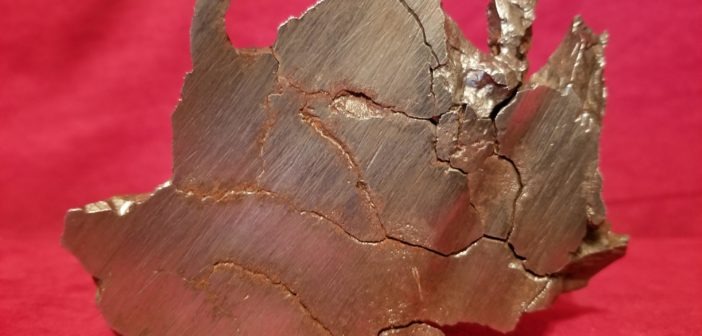
While digging near his home just off Two Tavern Road in Mount Joy Township, Mr. Snyder struck a massive metallic object buried just below the surface. What he uncovered would make history: an 847-pound iron meteorite, measuring approximately 11 by 24 by 33.5 inches.
At the time of its discovery, it was recognized as the largest meteorite ever found east of the Mississippi River, and the third largest in the United States. Its sheer size and unusual composition immediately drew the attention of scientists and collectors across the country.
A Window into the Cosmos
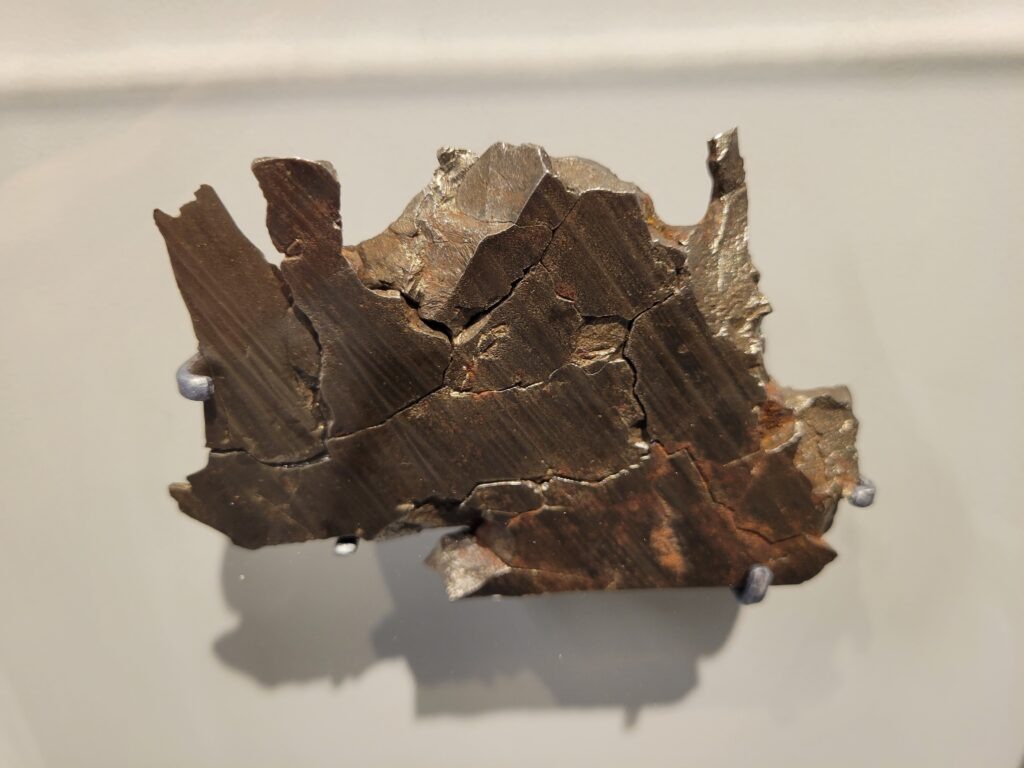
Classified as a medium octahedrite iron meteorite, the Mount Joy specimen is composed primarily of iron and nickel, with a crystalline structure that forms only under the incredibly slow cooling conditions found inside large asteroids. When cut and polished, it reveals intricate Widmanstätten patterns—a signature feature that makes such meteorites invaluable to science.
Where is it now?
Mr. Snyder offered his monolith for sale to fledgling Smithsonian Institute during the 19th Century. Being relatively new to the business of collecting and perhaps a bit short of funds, the institute rejected Mr. Snyder’s offer. Alas, the meteor ended up in the possession of a collector who chopped and sold small pieces of it. Eventually the largest piece found its way to the Naturhistorisches Museum Wien in Austria. It is said a small piece is owned by the current owner of the property also, passed down from one owner to the next.
- Naturhistorisches Museum Wien/Natural History Museum (Vienna Austria)
- The Smithsonian National Museum of Natural History (Washington, D.C.)
- Gettysburg Beyond the Battle Museum (Gettysburg, PA)
- Harvard University’s Mineralogical and Geological Museum
- The Field Museum (Chicago, Illinois)
- There are a number of smaller pieces held by private collectors
Over a century later, the Mount Joy Meteorite still inspires awe, curiosity, and a cosmic connection between a humble farmer’s field in Two Taverns and the vast expanse of the universe.